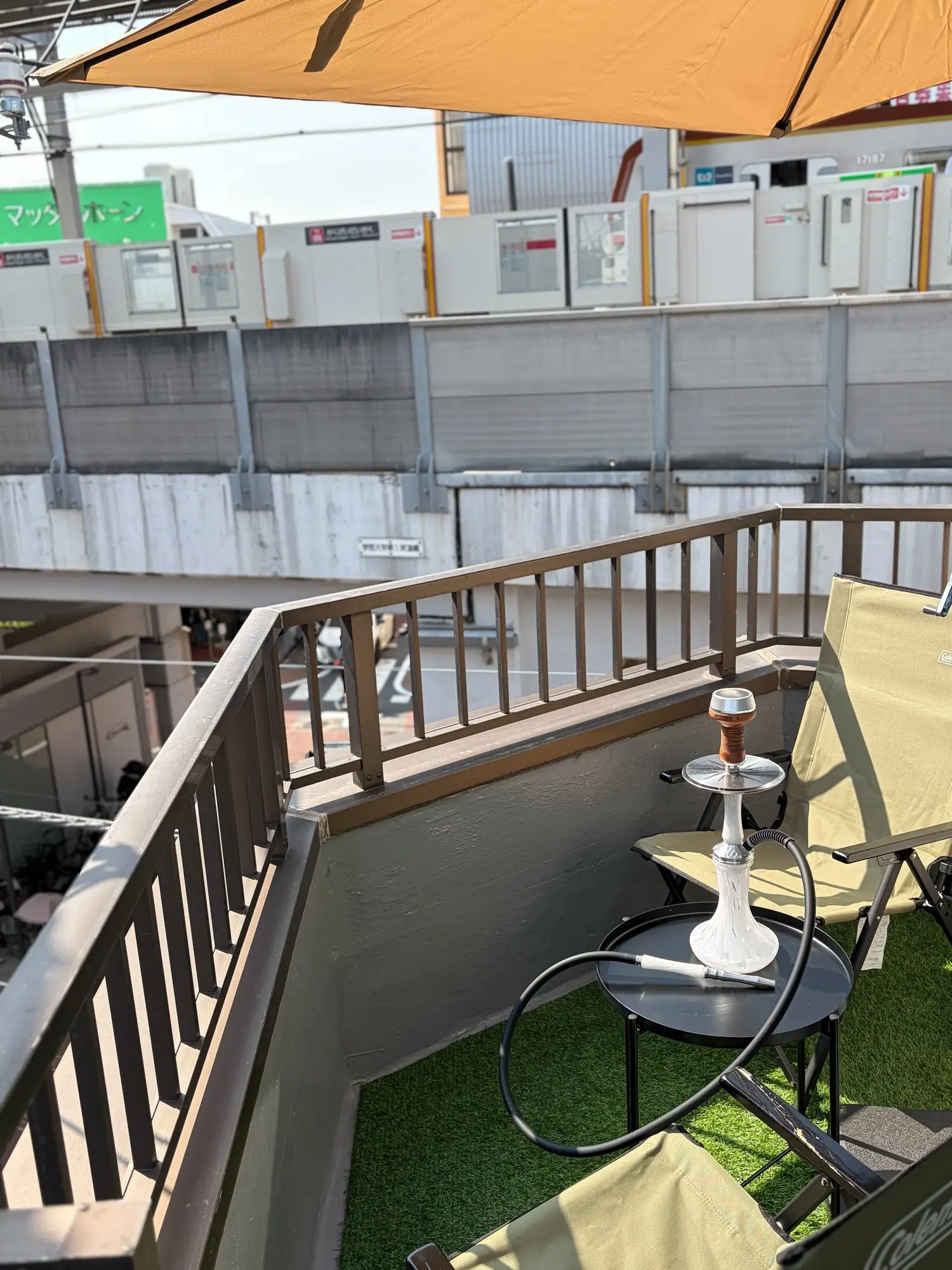
You may have come across products sold as an “e-hookah” or “electronic shisha,” often in the form of a slim device or a disposable vape. The name suggests an electronic version of the water pipe you smoke at a hookah lounge. In reality, electronic shisha and a traditional hookah, heated with charcoal and drawn through water, work differently and are treated differently under the law.
In Japan, “electronic shisha” (denshi shisha) is not an official term. It is a name sometimes used, mainly to refer to e-cigarettes. This guide sorts out the differences between electronic shisha as an e-cigarette and the original hookah (water pipe), based on public information from Japan’s Ministry of Health, Labour and Welfare (MHLW), the World Health Organization (WHO) and other public bodies. If you are visiting Japan, there is also a section on how the rules work here. This is not medical advice: if you have any concerns about your health, please talk to a doctor.
The short answer: e-hookah and hookah are different things
| Electronic shisha (e-cigarette) | Hookah (water pipe) | |
|---|---|---|
| How it works | A liquid containing flavorings and other ingredients is heated electrically, and you inhale the vapor | Tobacco leaf (or a substitute) is heated with charcoal, and the smoke is drawn through water |
| Heat source | Electricity | Charcoal |
| Tobacco leaf | Not used | Used (except nicotine-free flavors) |
| Nicotine | In Japan, selling nicotine-containing liquid requires a license | Contains nicotine (except nicotine-free flavors) |
| Legal status in Japan | Nicotine-free products are not classed as tobacco products under the Tobacco Business Act | A tobacco product. Not available to anyone under 20 |
How each one works
Electronic shisha (e-cigarettes and disposable vapes)
The MHLW’s e-health information site, e-Health Net, describes e-cigarettes as products that electrically heat a solution containing flavorings and other ingredients, so that you inhale the aerosol (vapor) that is produced. No tobacco leaf is used.
That is the whole mechanism: a battery-powered heater, a liquid and a vapor. Whether the device is refillable or a disposable vape, what you are inhaling comes from a heated liquid, not from tobacco leaf.
Hookah (water pipe)
Japan’s National Tax Agency describes a water pipe as something in which tobacco, or a product containing tobacco, is burned or heated, and the tobacco components are inhaled using a water pipe. Charcoal is used as the heat source, and the smoke passes through water before you draw it through the hose.
So while electronic shisha runs on electricity, a hookah relies on charcoal. That difference in heat source matters later, when we look at what public health bodies say about each. For the names and roles of each part of the pipe, see Parts of a Hookah: Names and What Each One Does. For how hookah compares with cigarettes and heated tobacco, see Hookah vs Cigarettes, Heated Tobacco and Vapes.
How it works in Japan: the rules travelers should know
If you are visiting Japan, the rules on e-cigarettes may differ from what you are used to at home. Here is what Japanese public bodies say.
For using e-cigarettes or heated tobacco at a hookah bar, see Can You Smoke Cigarettes at a Hookah Bar in Japan?.
Nicotine liquid is treated as a medicine
According to e-Health Net, under Japan’s Pharmaceuticals and Medical Devices Act (the PMD Act, known in Japanese as Yakkiho), a license is required to sell liquid that contains nicotine. In 2010, the MHLW and the Consumer Affairs Agency issued a notice stating that selling e-cigarettes containing nicotine is suspected of violating the Pharmaceutical Affairs Act (the former name of the law), as the sale of unapproved, unlicensed medicines.
Limits on bringing nicotine products in for personal use
On personal imports, the MHLW’s Q&A on import procedures for pharmaceuticals and related products says that cartridges and liquids containing nicotine count as medicines. The amount that can be imported without a confirmation procedure at customs is one month’s supply: up to 60 cartridges, or up to 120ml of liquid.
The same Q&A states that cartridges and liquids that do not contain nicotine are not subject to regulation under this law. The device itself, which heats the liquid, counts as a medical device, and personal imports are limited to one unit (two, including a spare).
| Item | How the MHLW Q&A treats it | Personal import without customs confirmation |
|---|---|---|
| Nicotine-containing cartridges | A medicine | Up to one month’s supply (60 cartridges) |
| Nicotine-containing liquid | A medicine | Up to one month’s supply (120ml) |
| Nicotine-free cartridges and liquid | Not regulated under this law | Not subject to these limits |
| The heating device | A medical device | One unit (two, including a spare) |
Nicotine-free products and age
e-Health Net explains that e-cigarettes without nicotine are not classed as tobacco products under the Tobacco Business Act, so they can be bought by young people, including minors.
A hookah, on the other hand, is a tobacco product. Smoking under the age of 20 is prohibited by law in Japan. Under the revised Health Promotion Act, people under 20 cannot enter smoking areas even if they do not intend to smoke. This is why a hookah lounge in Japan cannot admit anyone under 20, whatever they plan to do there. See Hookah Age Limit in Japan: Why It’s 20, Not 18.
Be careful with “nicotine-free” labels
In 2010, the MHLW reported that a survey by the National Consumer Affairs Center of Japan had detected nicotine in some e-cigarettes that were being sold as “nicotine-free.” The WHO also says that nicotine has been found in some products labeled as nicotine-free.
In other words, the label on the package is not a guarantee of what is in the liquid.
What public health bodies say about health
Electronic shisha (e-cigarettes)
- MHLW e-Health Net: says there are reports of products that generate carcinogens and other substances, such as formaldehyde and acetaldehyde, whether or not they contain nicotine.
- WHO: says the evidence makes clear that e-cigarettes are harmful to health and are not safe.
- U.S. Centers for Disease Control and Prevention (CDC): says there is no safe tobacco product, including e-cigarettes. Nicotine is highly addictive and can harm brain development, which continues until about age 25.
- Youth use in the U.S.: in the U.S. Food and Drug Administration’s (FDA) 2025 national survey, 5.2% of middle and high school students (about 1.44 million) were using e-cigarettes. Among those users, disposable devices were the most commonly used type (66.3%).
- EVALI in the U.S.: the CDC reports that in 2019 and 2020, an outbreak of serious lung injury associated with the use of e-cigarette, or vaping, products (EVALI) occurred in the U.S. As of February 18, 2020, 2,807 people had been hospitalized or had died (68 confirmed deaths). The CDC says vitamin E acetate was strongly linked to the outbreak, and that many cases were linked to products containing THC (a component of cannabis).
So “it’s only vapor” is not how these public bodies describe e-cigarettes, and the same applies to disposable vapes.
Hookah (water pipe)
- The water does not filter the smoke (CDC).
- The charcoal can produce high levels of carbon monoxide, metals and carcinogens (CDC).
- Even with nicotine-free flavors, carbon monoxide is still produced as long as charcoal is used (CDC).
In other words, neither side of the “e-hookah vs hookah” question is described as safe. For more on hookah’s risks, see Is Hookah Dangerous? Risks, Myths and How to Reduce Them. For nicotine-free options, see What Is Nicotine-Free (Herbal) Shisha?.
Common misconceptions
“Electronic shisha is just the electronic version of hookah, so they’re the same thing.”
The names are similar, but electronic shisha is an e-cigarette that heats a liquid with electricity, while a hookah heats tobacco leaf (or a substitute) with charcoal and draws the smoke through water.
“If it’s nicotine-free, it has no effect on the body.”
e-Health Net says there are products that generate carcinogens and other substances whether or not they contain nicotine. The WHO also says e-cigarettes are not safe.
“If you can buy electronic shisha, you can go into a hookah lounge.”
People under 20 cannot enter the smoking area of a hookah lounge in Japan. That is a separate matter from how the purchase of nicotine-free e-cigarettes is treated.
FAQ
Is there an age limit for electronic shisha in Japan?
e-Health Net says that e-cigarettes without nicotine are not classed as tobacco products under the Tobacco Business Act, so young people, including minors, can buy them. A hookah (water pipe), by contrast, is only available to people aged 20 and over.
Is electronic shisha bad for you?
The WHO says e-cigarettes are harmful to health and not safe. e-Health Net also says there are products that generate carcinogens and other substances whether or not they contain nicotine.
Can I buy nicotine vape liquid in Japan?
Under the PMD Act, a license is required to sell liquid that contains nicotine (e-Health Net). The MHLW and the Consumer Affairs Agency stated in 2010 that selling nicotine-containing e-cigarettes is suspected of being the sale of unapproved, unlicensed medicines.
Can I bring my own nicotine vape into Japan?
The MHLW Q&A treats nicotine-containing cartridges and liquid as medicines. Without confirmation at customs, you can bring in one month’s supply: up to 60 cartridges or 120ml of liquid. The heating device counts as a medical device, limited to one unit (two, including a spare). Nicotine-free cartridges and liquids are not regulated under this law.
Is a disposable vape the same as a hookah?
No. A disposable vape is an e-cigarette: it heats a liquid electrically and uses no tobacco leaf. A hookah heats tobacco leaf (or a substitute) with charcoal and passes the smoke through water. In the FDA’s 2025 survey, disposables were the type most used by young e-cigarette users in the U.S.
Is a “nicotine-free” vape guaranteed to contain no nicotine?
Not necessarily. The MHLW reported in 2010 that nicotine was detected in some e-cigarettes sold as nicotine-free, and the WHO says the same has been found in some products.
Does a nicotine-free hookah avoid carbon monoxide?
No. The CDC says that as long as charcoal is used, carbon monoxide is produced, even with nicotine-free flavors.
Can I use electronic shisha at a hookah lounge?
It depends on the place. Ask the staff before you use one.
Summary
- “Electronic shisha” is not an official term; in Japan it is a name sometimes used mainly for e-cigarettes.
- Electronic shisha heats a liquid with electricity; a hookah heats tobacco leaf (or a substitute) with charcoal and draws the smoke through water.
- In Japan, selling nicotine-containing liquid requires a license under the PMD Act, and personal imports of nicotine products are limited.
- Nicotine-free e-cigarettes are not classed as tobacco products under the Tobacco Business Act. A hookah, by contrast, is for ages 20 and over only.
- Public bodies do not describe either e-cigarettes or hookah as safe.
How it works at shisha bar IORI (Gakugei-daigaku, Tokyo)
- Traditional charcoal-heated hookah (water pipe)
- 36 nicotine-free flavors
- We ventilate the room thoroughly and check indoor carbon monoxide levels regularly with a CO monitor
- Ages 20+ only
References
- Ministry of Health, Labour and Welfare, e-Health Net, “E-cigarettes” (Japanese)
- Ministry of Health, Labour and Welfare, notice on e-cigarettes containing nicotine, 2010 (Japanese)
- Ministry of Health, Labour and Welfare, “On the use of e-cigarettes,” 2010 (Japanese)
- Ministry of Health, Labour and Welfare, Q&A on import procedures for pharmaceuticals and related products, 2025 (Japanese)
- National Tax Agency, FY2018 tax reform: tobacco tax (Japanese)
- Ministry of Health, Labour and Welfare, “Let’s end unwanted secondhand smoke” (Japanese)
- World Health Organization, “Tobacco: E-cigarettes”
- Centers for Disease Control and Prevention, “Health Effects of Vaping”
- Centers for Disease Control and Prevention, “Outbreak of Lung Injury Associated with the Use of E-Cigarette, or Vaping, Products” (archive)
- Centers for Disease Control and Prevention, “Hookahs”
- U.S. Food and Drug Administration, “Results from the Annual National Youth Tobacco Survey”