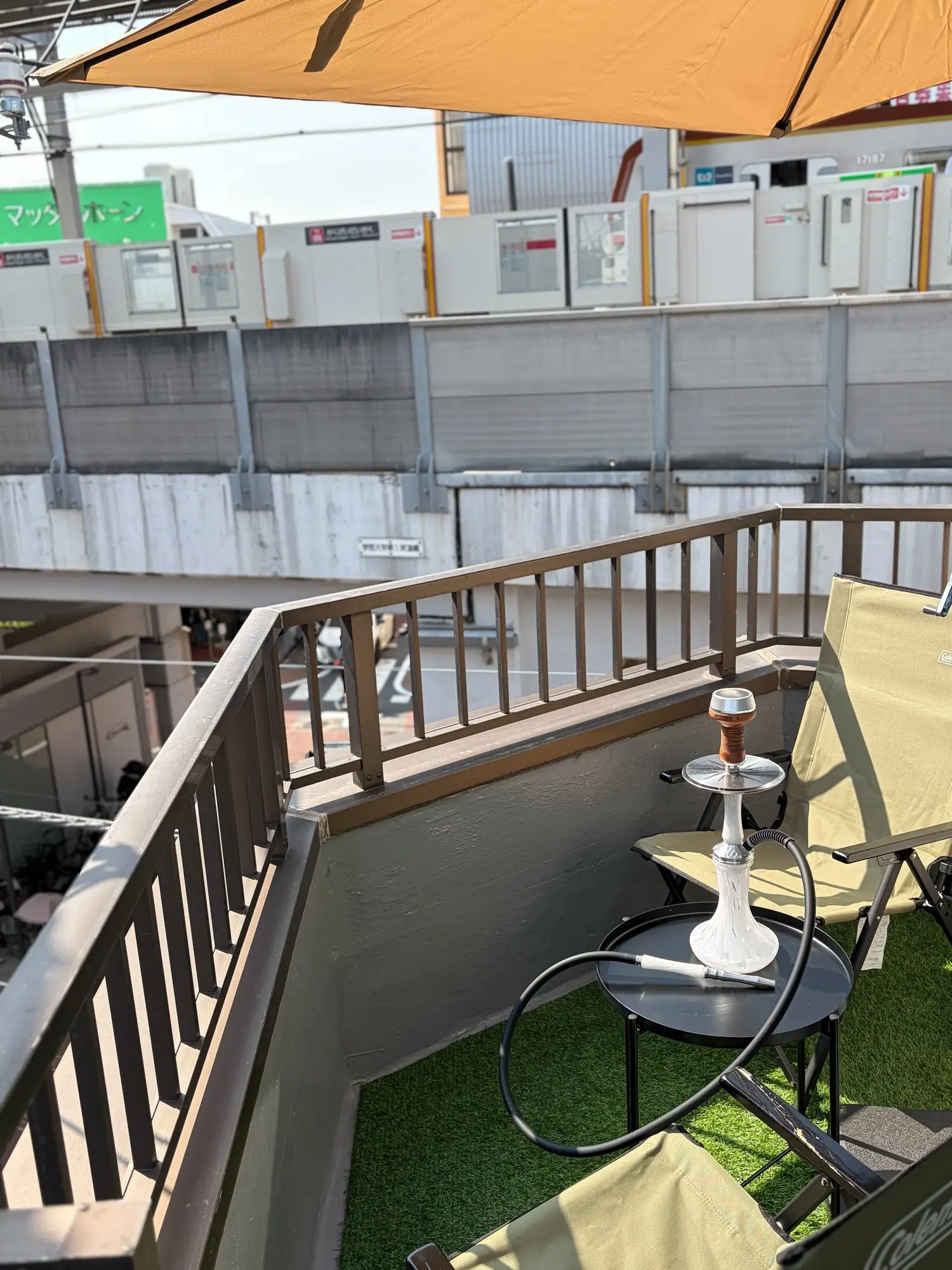
After enjoying hookah at a lounge a few times, some people start to wonder whether they could smoke at home too. It is possible, but a hookah at home comes with points to watch that are different from smoking at a shop. The two most important are the carbon monoxide given off by the charcoal, and the handling of fire.
This guide covers what you need to set up a hookah at home, how to think about the costs, how the charcoal is prepared, and the safety points everyone should know before lighting a single coal. It is based on information from public bodies, including the Tokyo Metropolitan Government, the Tokyo Fire Department and the U.S. Centers for Disease Control and Prevention (CDC), along with hookah makers and a specialist publication. It is written for people living in Japan and for travelers who have tried hookah here and are thinking about it back home. If you are unsure whether you can manage the safety measures, don’t force it: consider enjoying hookah at a shop that has proper ventilation and management instead.
First things first: charcoal and carbon monoxide
A hookah works by using charcoal to heat the flavor (the shisha tobacco or herbal mix). That charcoal is the key to understanding the safety side. One study found that about 90% of the carbon monoxide in hookah smoke comes from the charcoal (Monzer et al., 2008). In other words, the danger is built into the heat source itself, not just the flavor you choose.
Here is what public bodies say:
- The CDC: do not burn charcoal indoors. To prevent carbon monoxide poisoning, the CDC advises people not to burn charcoal inside the home. This is the single most important point in this guide.
- The Tokyo Metropolitan Government reports that when one hookah was used in a closed space of about 10 square meters, the carbon monoxide concentration reached about 300 ppm, a level at which headaches and nausea would appear within one to two hours.
- The Tokyo Metropolitan Government also warns that in an enclosed space, carbon monoxide poisoning is a risk not only for the person smoking but for everyone else in the room.
Smoking hookah at home means handling that charcoal inside your home. Put plainly, it runs against the CDC’s advice unless you take serious precautions. If your home is somewhere you cannot follow the safety measures below, avoid smoking hookah there at all.
The equipment and supplies you need
Japan Shisha Times, a Japanese specialist publication, lists the following as what you need to start smoking hookah at home.
| Category | What you need |
|---|---|
| The hookah itself | The pipe (stem, base and hose) |
| Around the bowl | A bowl (also called the top), and a heat management device (HMS) or aluminum foil |
| For the charcoal | Charcoal, and something to heat it, such as an electric heater |
| Consumables | Flavor, water, and a damp paper towel to use while packing the bowl |
For beginners, the same publication recommends flat charcoal heated on an electric heater. For the name and role of each part of the pipe, see Parts of a Hookah: Names and What Each One Does.
How to think about costs
Prices vary widely from product to product, so rather than quoting numbers, this section sorts out the items you should budget for.
- Up-front costs: the hookah itself, a bowl, a heat management device, and a heater to heat the charcoal.
- Costs every session: flavor, charcoal, and aluminum foil (if you use it).
- Costs for safety: a carbon monoxide alarm (see below).
The last line is easy to skip when you are shopping for a pipe, but it belongs on the list from day one, not as an optional extra.
It also helps to think about what you are really taking on. At a shop, the shop takes care of the equipment, the charcoal and the ventilation. At home, you have to provide and manage all of that yourself.
How the charcoal is prepared
Hookah makers and a specialist publication describe preparing natural charcoal roughly like this:
- Place the coals on an electric heater or similar and heat them (Japan Shisha Times).
- Turn them over partway through.
- Wait until each coal is glowing red all over, with no black parts left (Al Fakher).
- Only once the coals are fully lit, take them off the heater and move them onto the bowl (Fumari).
Patience is part of the process. According to Fumari, coconut charcoal takes around 8 to 12 minutes to light fully. Moving coals to the bowl before they are completely lit goes against the steps above, so let the heater do its job. For more on the types of charcoal and on coal changes, see Hookah Charcoal Explained: Coconut vs Quick-Light Coals, Coal Changes and Carbon Monoxide.
Protecting yourself from carbon monoxide
Everything in this section builds on the CDC’s basic advice not to burn charcoal indoors. If you still choose to smoke at home, these are the measures public bodies point to. No single one is enough by itself; they work together.
Ventilate thoroughly
The Tokyo Metropolitan Government calls on people to lower indoor carbon monoxide levels by running a ventilation fan and opening doors and windows. In the Tokyo government’s own test, carbon monoxide levels dropped significantly when a door was opened to ventilate the room. The Tokyo Fire Department likewise advises using a ventilation fan and opening windows regularly to let fresh air in.
Keep in mind that the roughly 300 ppm reading mentioned above came from a closed room of about 10 square meters. That is why ventilation is not something to do once at the start and then forget: the fan should run and the windows should be opened regularly throughout the session.
Install a carbon monoxide alarm
The Tokyo Fire Department says that installing an alarm that detects carbon monoxide is effective for early detection. The CDC also recommends installing a carbon monoxide detector that is battery-operated or has a battery backup. This is why a CO alarm appears in the cost list above.
Notice changes in how you feel, right away
- If you feel a headache, dizziness or nausea, stop smoking immediately and get some fresh air.
- Don’t smoke when you feel sleepy. The CDC warns that people who are sleeping or have been drinking can die from carbon monoxide poisoning before they have any symptoms.
- Take particular care if you are drinking alcohol at the same time. See Hookah and Alcohol: What to Know Before Drinking While You Smoke.
For symptoms, what to do, and when to call an ambulance, see Feeling Sick After Hookah? Nicotine vs Carbon Monoxide, and What to Do.
Preventing fire and burns
Carbon monoxide is not the only hazard. Burning charcoal also brings the risk of burns and fire into your home.
- Don’t touch the charcoal or hot parts. The Tokyo Metropolitan Government points out that the charcoal itself, and any part in contact with it, gets extremely hot.
- Don’t let the hookah tip over. The Tokyo Metropolitan Government warns that if the pipe falls over and the charcoal drops out, it can cause a fire. Set it on a stable surface and avoid tugging hard on the hose.
- Keep flammable things away. Use the hookah away from curtains and paper.
- Deal with used charcoal carefully. Clear it away only after you have confirmed that the fire is completely out.
The law in Japan: no one under 20
If you plan to smoke hookah at home in Japan, the legal rules apply just as they do in a shop.
- Smoking by anyone under 20 is prohibited by law in Japan. This applies inside the home too.
- Anyone who sells tobacco or smoking equipment knowing that it will be used by someone under 20 faces a fine of up to ¥500,000 (the Act on the Prohibition of Smoking by Minors, which in Japan covers anyone under 20).
- The Kinki Local Finance Bureau states that selling water pipe tobacco requires a tobacco retail license. Buy your flavors (shisha tobacco) from a licensed seller.
For more on the age limit, see Hookah Age Limit in Japan: Why It’s 20, Not 18, and Why Under-20s Can’t Enter.
FAQ
Is nicotine-free shisha safe to smoke at home?
No. Nicotine-free or not, if you use charcoal, carbon monoxide is produced.
Isn’t it enough to open a window a little?
How well a room is ventilated varies from room to room. Use both a ventilation fan and windows, install a carbon monoxide alarm, and combine several measures rather than relying on one.
Is it better to smoke at a shop or at home?
At home, you have to manage the equipment, the charcoal and the ventilation all by yourself. If you are not confident about the safety measures, enjoying hookah at a shop is the better choice.
Where does the carbon monoxide in hookah smoke come from?
Mostly from the charcoal. One study found that about 90% of the carbon monoxide in hookah smoke comes from the charcoal (Monzer et al., 2008), which is why the CDC’s advice not to burn charcoal indoors matters so much here.
Does the danger only affect the person smoking?
No. The Tokyo Metropolitan Government warns that in an enclosed space, everyone nearby is at risk of carbon monoxide poisoning, not only the person smoking.
What kind of carbon monoxide alarm should I get?
The CDC recommends a carbon monoxide detector that is battery-operated or has a battery backup, and the Tokyo Fire Department says a CO alarm helps with early detection.
Summary
- At home, managing the carbon monoxide from the charcoal and the fire is entirely your own responsibility.
- The CDC advises not burning charcoal indoors. If you cannot follow the safety measures, don’t smoke hookah at home.
- You need the pipe, a bowl, a heat management device, charcoal, a heater, flavor, and a carbon monoxide alarm.
- Ventilate with both a fan and windows, and stay alert to any change in how you feel.
- No one under 20. Buy flavors from a licensed seller.
How it works at shisha bar IORI (Gakugei-daigaku, Tokyo)
- We ventilate the room thoroughly and check indoor carbon monoxide levels regularly with a CO monitor
- Our staff handle charcoal preparation, coal changes and equipment care
- Ages 20+ only
References
- Japan Shisha Times, the basics of home shisha (Japanese)
- Fumari, “How to Set Up a Hookah”
- Fumari, “Hookah Coal Buying Guide”
- Al Fakher, “Build Your Shisha”
- Tokyo Metropolitan Government press release, March 2025: water pipes (shisha) carry a risk of carbon monoxide poisoning (Japanese)
- Tokyo Kurashi Web (Tokyo Metropolitan Government), product test of water pipes (Japanese)
- Tokyo Fire Department, “Beware of carbon monoxide poisoning” (Japanese)
- Centers for Disease Control and Prevention, “Carbon Monoxide Poisoning Basics”
- Monzer B, et al. Food and Chemical Toxicology, 2008 (sources of carbon monoxide and PAHs in hookah smoke)
- e-Gov Law Search, Act on the Prohibition of Smoking by Minors (Japanese)
- Kinki Local Finance Bureau, “Tobacco Business Act FAQ” (Japanese)